Walk into almost any newly finished building in Qatar and you'll notice it within seconds.
The echo. The hum. The way a single conversation on the other side of the room somehow lands directly in your ear. You can't see the problem — but you feel it immediately, and it doesn't go away.
It happens in boardrooms where confidential meetings aren't confidential at all. In schools where teachers are exhausted by lunchtime from projecting their voice over a classroom that throws sound back at them. In hotel lobbies that look stunning in the photographs but feel like standing inside a mixing bowl in real life.
Here's the thing nobody tells you upfront: most of Qatar's most popular design choices — the marble floors, the high ceilings, the glass walls, the polished concrete — are acoustically terrible. They look incredible. They perform poorly. And once the building is finished, most clients simply accept the noise as part of life.
They shouldn't have to.
The right Acoustic Panels Qatar specification, chosen early and installed properly, solves the problem completely. This guide explains how — and what to look for before you commit to a product.
Why Qatar's Buildings Have an Acoustic Problem Nobody Talks About
This isn't a quality issue. Qatar's buildings are exceptionally well constructed. The acoustic problem is a design culture issue — and it's completely understandable.
For decades, interiors across the Gulf prioritised visual impact above everything else. Marble, glass, high ceilings, open plans. These are the hallmarks of premium space. They photograph beautifully. They impress clients on a first visit.
What they don't do is absorb sound. Every hard surface in a room is a mirror for noise — and when you stack multiple hard surfaces together, sound bounces between them in a cycle that creates the reverberation and echo that makes spaces uncomfortable to be in for long periods.
The Spaces Where It Shows Up Most
Some environments feel the impact more than others:
Corporate offices and boardrooms — where a meeting that should feel private ends up audible to the entire floor, and concentration becomes a constant effort rather than a natural state.
Schools and universities — where research consistently links poor classroom acoustics to reduced comprehension, increased teacher fatigue, and lower attainment — particularly for students learning in a second language.
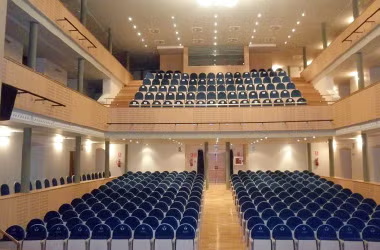
Auditoriums and conference halls — where a speaker at the front of the room sounds clear to the first three rows and incomprehensible to the last ten.
Hotels and restaurants — where the ambient noise level during a busy service makes normal conversation feel like hard work.
Mosques and community spaces — where the reverberation from stone and tile surfaces turns spoken recitation into an overlapping blur.
The common thread in all of these? Hard surfaces, high ceilings, and an acoustic environment that was never properly planned.
What Acoustic Panels Actually Do — and Why Fabric Panels Work So Well
An acoustic panel doesn't block sound from entering or leaving a room. What it does is absorb sound energy at the surface — catching the sound wave before it has the chance to bounce back into the room and add to the reverberant noise field.
The result isn't silence. It's clarity. Voices sound cleaner. Music sounds more defined. Background noise drops to a level that stops demanding your attention.
Why Fabric-Wrapped Panels Are the Most Popular Choice
Fabric acoustic panels are the go-to solution for most commercial and educational interiors — and it's not hard to see why.
At their core is a layer of high-density sound-absorbing material, usually rockwool or fibreglass. This is wrapped in an acoustically transparent fabric that lets sound pass through to the absorbing layer beneath, while presenting a clean, professional surface to the room.
The fabric can be specified in virtually any colour or texture. Panels can be cut to almost any size. They can be mounted flush to the wall, recessed into a reveal, or suspended as ceiling baffles. From a distance, a well-installed fabric panel looks like a considered design choice rather than a technical fix — because done well, it is both.
When Timber Panels Are the Better Answer
In spaces where the visual quality of the finish is the primary concern — premium hotel lobbies, executive boardrooms, high-end residential — timber acoustic panels often make more sense. Precision-grooved or perforated MDF and hardwood panels deliver strong acoustic performance with a warmth and texture that fabric simply can't replicate. They read as architectural detail, not acoustic treatment.
Ceiling Panels and Baffles for High-Volume Spaces
In open-plan offices, sports halls, warehouses, and large hospitality spaces, wall space is often limited and the acoustic problem originates from above. Ceiling-mounted panels and suspended baffles address this directly — providing absorption at height, where the long reflections that create the most disruptive echo are generated.
Why One Panel Type Is Never the Whole Answer
This is where a lot of projects fall short. A client specifies acoustic panels for the walls, the installation looks great, and then they're surprised that the problem hasn't fully resolved.
That's usually because the ceiling is still entirely reflective. Or the floor. Or both.
Genuine Acoustic Solutions treat the whole room — not just one surface. The most effective acoustic environments combine wall panels with ceiling treatment, and in some cases, floor finishes and acoustic partitions that control how sound moves between zones.
H3: Acoustic Partitions — The Underused Tool
Movable acoustic partitions deserve more attention than they get. In conference centres, schools, and hotel event spaces, a folding partition system turns one large reverberant hall into two or three smaller rooms — each with its own acoustic character, each suitable for a different use at the same time.
The operational flexibility alone makes them worth considering in any multi-purpose space. The acoustic improvement is a significant added benefit.
H3: Why Buying Local in Qatar Makes a Practical Difference
There is a real and practical difference between specifying acoustic panels from an international supplier and working with a manufacturer based in Qatar.
Lead times are shorter. Customisation is easier. Panels can be made to the exact dimensions of your space rather than cut down from standard sizes. And when something on site needs adjusting — a reveal that's slightly out, a dimension that changed during construction — you're working with a team that can respond quickly rather than waiting weeks for a revised shipment.
Beyond logistics, a local specialist understands the specific conditions that affect acoustic performance in Qatar — the building types, the climate, the finishes most commonly used, and the compliance requirements that apply to commercial and public spaces.
Four Questions to Answer Before You Specify Anything
Get these right and the rest of the process becomes straightforward.
What is the acoustic problem you're actually trying to solve? Reducing echo in a boardroom is a different brief to controlling noise transmission between a restaurant and a hotel corridor. The product specification follows from the problem, not the other way around.
How much surface area needs treatment? Acoustic performance is proportional to coverage. Too little treatment and the improvement is marginal. An acoustic assessment gives you a clear target before any money is spent.
What does the finished space need to look like? Acoustic performance and interior design quality are not in conflict. The best installations are the ones where the acoustic treatment and the interior design were specified together, not bolted on as an afterthought.
Does the product meet Qatar's fire and safety standards? In any commercial or public building, this is non-negotiable. Confirm compliance with your supplier before you finalise the specification.
Conclusion
Qatar's built environment is maturing fast. The expectation from clients — whether they're fitting out a corporate campus, a school, a hotel, or a residential development — is that every element of the finished space performs as well as it looks.
Sound is no longer the detail that gets ignored until complaints start arriving. It's part of the brief. And when it's handled properly — through well-specified Acoustic Panels Qatar and a considered whole-room approach to Acoustic Solutions — the difference in how a space feels to be in is immediate, obvious, and lasting.




Write a comment ...